How water secure Gram Panchayats respond to India’s water bankruptcy
FeatureBy Aravind A R
29 January 2026
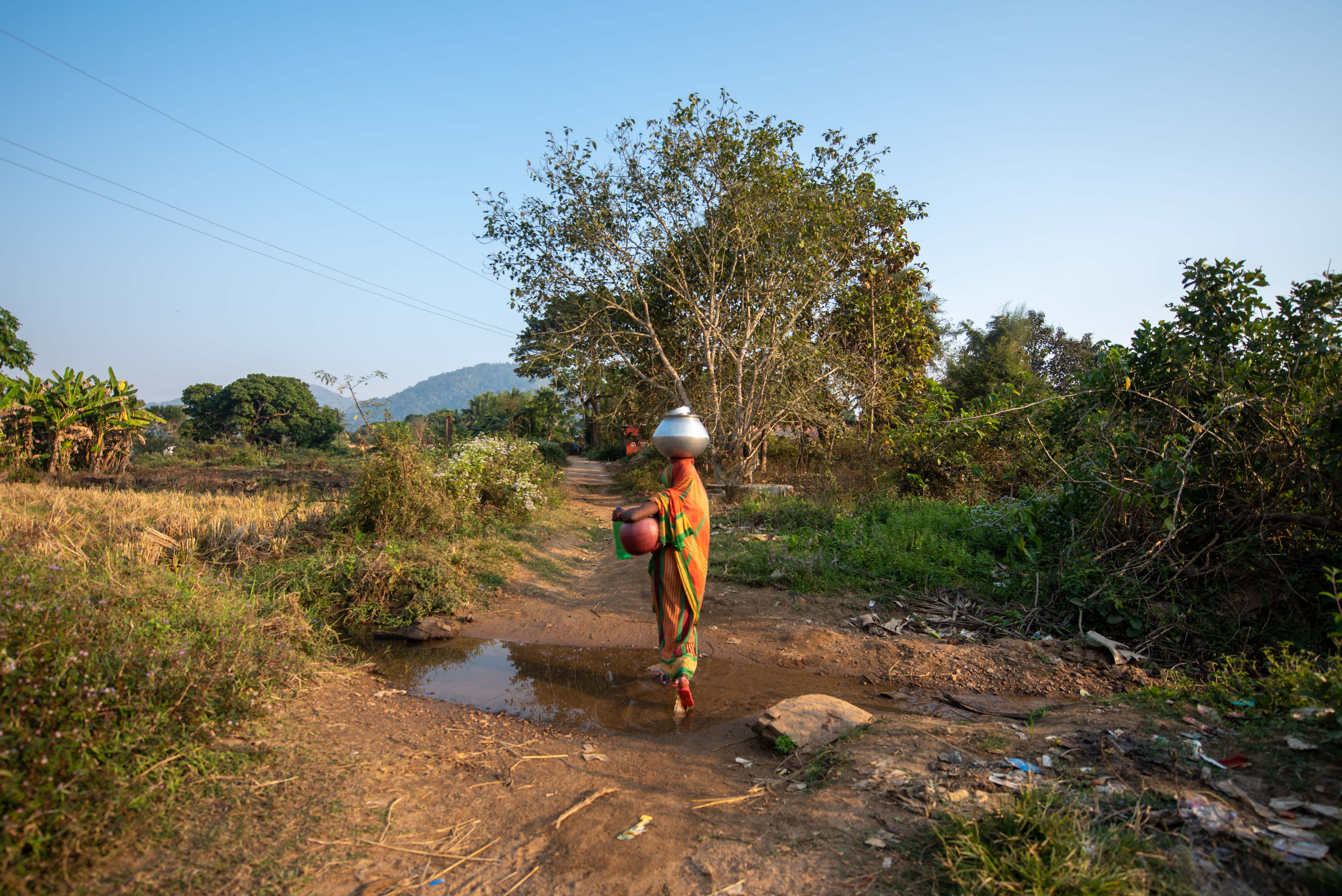
According to the UN, women and girls bear a disproportionate burden of the global water crisis, performing nearly 90% of the arduous labor of fetching water in rural areas. Photograph by Ajaya Behera
In early 2026, the United Nations warned that large parts of the world are moving towards “water bankruptcy”: a condition where water demand persistently exceeds the capacity of ecosystems and institutions to replenish, regulate, and govern it. Unlike drought, water bankruptcy is not episodic. It reflects the exhaustion of natural systems, the erosion of local governance, and the cumulative neglect of long-term stewardship.
In rural India, this condition is no longer a future risk. It is already visible in drying springs, failing piped water systems, declining farm productivity, and intensifying conflict over access. Odisha’s hilly and forested districts sit at the frontline of this crisis.
Gram Vikas’s Water Secure Gram Panchayat (WSGP) programme emerges from five decades of practice in these landscapes. It represents a deliberate shift from delivering water infrastructure to rebuilding the hydrological, institutional, and social systems that make water security durable.
When sources begin to fail
As Gram Vikas enters its fifth decade, the water challenge in eastern India has fundamentally shifted. It has moved from extending access to ensuring the long-term viability of water sources under climate stress.
Across central and eastern India, more than 90 million rural people are exposed to intensifying climate and water stress. In Odisha’s Eastern Ghats, where Scheduled Tribe and Scheduled Caste communities form a significant share of the population, this stress is magnified by geography, forest degradation, and historical exclusion from public systems.
Between 2001 and 2019, Odisha lost over 1,655 square kilometres of forest cover, much of it in the Eastern Ghats. This loss has weakened the land’s capacity to absorb rainfall, increased soil erosion, and disrupted groundwater recharge. At the same time, rainfall patterns have become increasingly erratic. The average number of rainy days has fallen from around 120 to fewer than 90 each year, resulting in intense runoff rather than sustained infiltration.
With nearly 70 percent of households dependent on rain-fed agriculture, these changes have immediate consequences. Livelihoods are destabilised. Food security is threatened. Field studies in Gram Vikas’s intervention areas show that water availability in critical sources is declining, with several springs shifting from perennial to seasonal.
This reflects the core dynamics of water bankruptcy, where sustained extraction outpaces replenishment and governance systems lack the capacity to respond.
Why water security must be governed, not delivered
The Water Secure Gram Panchayat programme was developed in response to this reality. It marks a clear transition from infrastructure-led service delivery to governance-anchored water security.
WSGP defines water security not simply as access, but as a condition produced through four interlinked pillars: Sustainability, Safety, Prosperity, and Equity & Resilience. Together, these address the ecological, health, economic, and institutional dimensions of water systems.
The Gram Panchayat is treated as the unit of intervention. This ensures that water planning, regulation, and accountability are embedded within local democratic institutions, rather than remaining project-bound or externally managed.
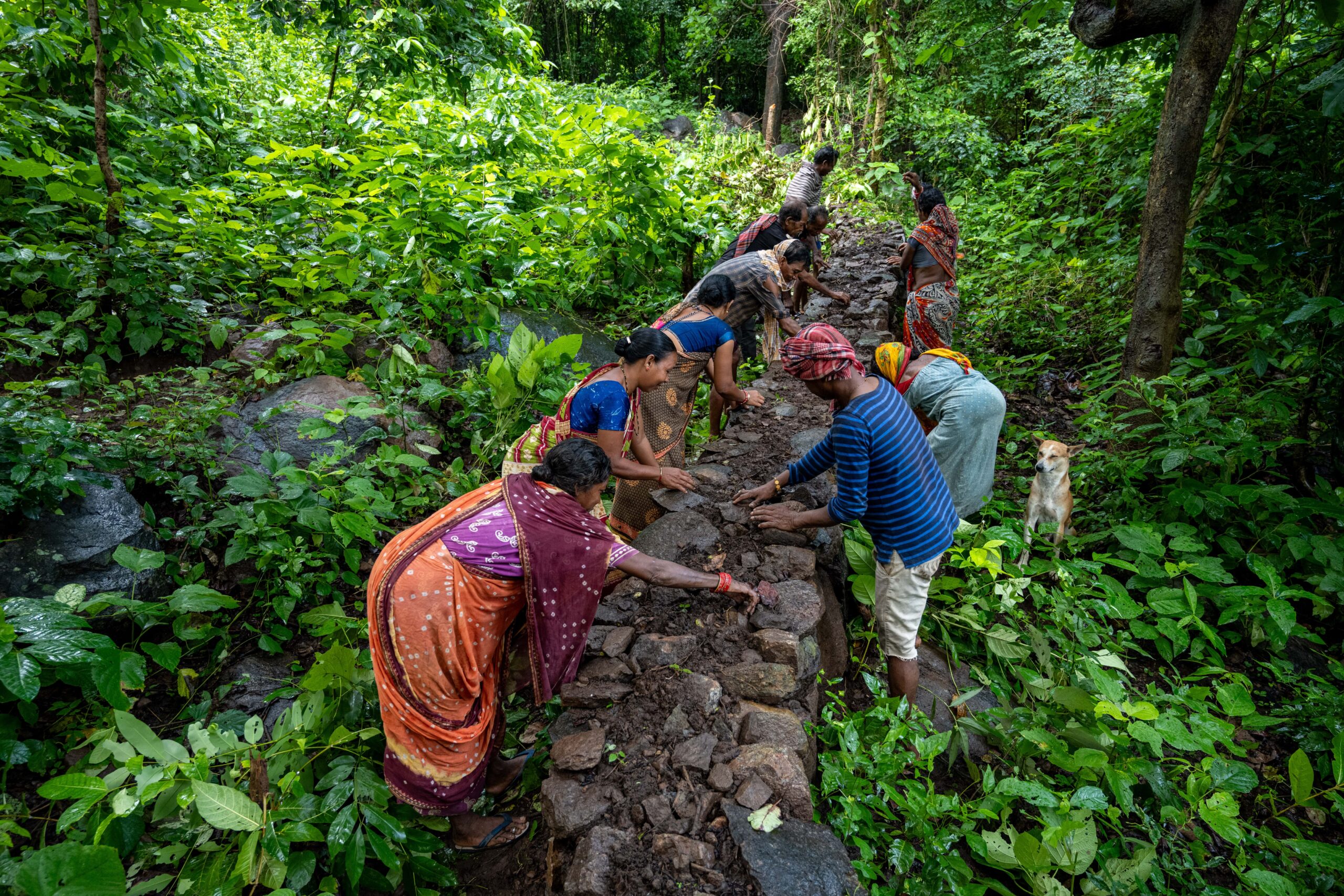
Comprehensive Sourceshed Development in action: Communities construct stone bunds to slow runoff and improve groundwater recharge. Photo: Ajaya Behera
Sustainability: Restoring the hydrological cycle
Long-term water security depends on ensuring that withdrawal does not exceed recharge. WSGP places source sustainability at the centre of its approach through systematic springshed management. This involves treating the catchment areas of springs to improve infiltration and percolation, mapping aquifers, and using water science to guide local planning. Communities work with Panchayats to develop water security plans that align land use, forest regeneration, and water demand.
By restoring degraded landscapes and rebuilding natural recharge processes, WSGP addresses water scarcity at its ecological root, rather than compensating for failure through deeper extraction or larger infrastructure.
Safety: Health as a non-negotiable baseline
Safe water remains a foundational concern within WSGP, with a focus on contamination prevention, source protection, and community-led monitoring. This work recognises the intimate relationship between water quality, sanitation practices, and environmental hygiene. By strengthening local capacity to test, monitor, and manage water safety, the programme ensures that gains in access do not unravel through preventable health risks.
Prosperity: Water as an economic enabler
In rural economies, water reliability directly shapes livelihood outcomes. WSGP approaches water as a productive asset that must be used efficiently and equitably. The programme supports small and marginal farmers to optimise water use, adopt climate-appropriate practices, and reduce risk. Tools such as local weather stations and crop advisories enable more informed decision-making, particularly in increasingly volatile climatic conditions.
By linking water governance to livelihood planning, WSGP recognises that economic resilience and hydrological sustainability must advance together.
Equity and resilience: Governing water in unequal landscapes
Water stress amplifies existing inequalities. Women, land-poor households, and marginalised communities bear disproportionate costs when systems fail.
WSGP explicitly addresses these asymmetries by strengthening inclusive decision-making within Gram Panchayats. Women, youth, and vulnerable households are engaged in planning, monitoring, and governance processes. Social protection mechanisms are integrated into water security strategies, recognising that resilience is as much social as it is ecological.
This emphasis on inclusive governance strengthens the legitimacy and durability of local water institutions, which is essential for responding to climate shocks and long-term uncertainty.
Evidence from the ground
The shift from infrastructure delivery to landscape-level governance is reflected in emerging outcomes.
Community-led restoration efforts have treated 5,065 hectares of degraded land and reforested 697 hectares with diverse native species. These nature-based interventions have restored natural recharge processes, contributing to a documented 15 percent increase in water availability in critical sources and recharging an estimated two million cubic metres of water.
In terms of access and safety, over 130,000 people now have functional tap water connections at home, reducing the physical burden on women and improving public health conditions. Livelihood outcomes have also strengthened. Nearly 10,000 small and marginal farming households report improved incomes through reliable irrigation and better agronomic practices. Winter season farm incomes in these villages have risen by an average of 33 percent, while agroforestry initiatives have generated an additional ₹25 million.
These outcomes reflect the repair of ecological systems and the rebuilding of local governance capacity.
In the context of accelerating climate risk, water security requires sustained governance, adaptive management, and long-term institutional stewardship. When equipped with appropriate authority, knowledge, and public legitimacy, the Gram Panchayat represents a critical locus for this work.
A vision of a Water Secure Gram Panchayat: integrating sustainability, safety, prosperity, and equity to build climate resilience across the landscape. Photograph by Ajaya Behera
ACKNOWLEDGEMENT
Priya Pillai edited the article. Photographs by Ajaya Behera.
ABOUT THE AUTHOR
Aravind A R worked with Gram Vikas between 2019 and 2024, supporting village institutions within the WSGP programme. He is currently the Lead Account Manager at Wordmatter Communications, where he supports development organisations to build communication capacities.


RELATED BLOGPOSTS
From Daringbadi to Nepal: A journey of climate, livelihoods, and hope
Astina Raika shares his experience from a exposure trip to Nepal.
Rural Odisha farmers enter carbon credit market in grassroots climate push
Farmers in Odisha lead community-driven agro and social forestry, earning carbon credits while restoring degraded lands.
Stories travel through cinema to rural doorsteps in remote corners of Odisha
Cinema that stirred hearts, sparked hope, and found purpose and voice for environmental change.