A small Adivasi village takes big steps to secure its water future
StoryBy Lalit Kumar Naik
22 August 2025
Adivasi residents in Bada Antarsing build stone bunds to recharge groundwater and ensure continued water availability during summers.
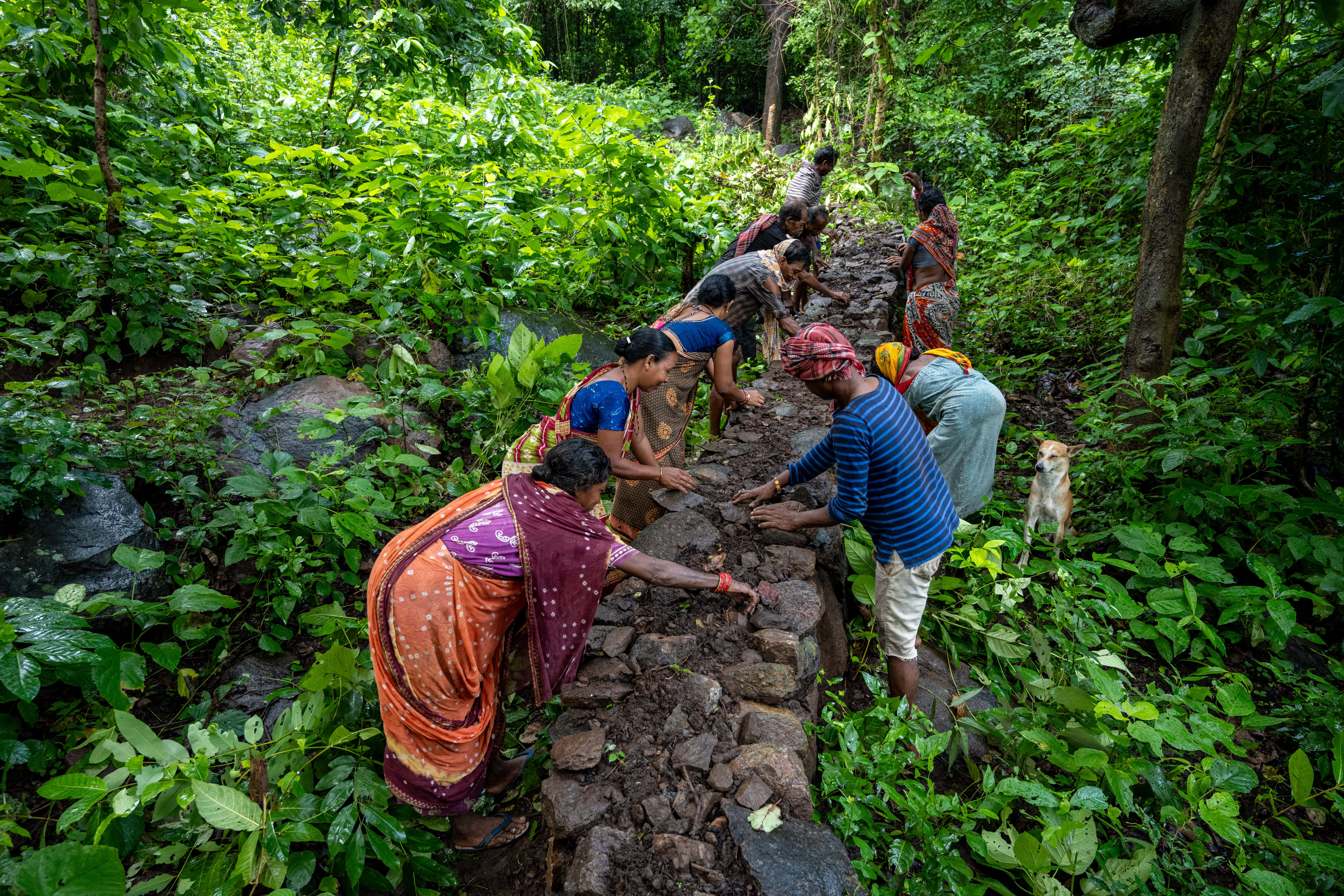
The community members built 2500 feet of stone bunds across three acres of hilly terrain around the water source.
Photograph from Gram Vikas Archive
Bada Antarsing, a small Adivasi village in the hills of Rayagada block in Odisha’s Gajapati district, is home to 21 families. The villagers primarily engage in farming and work as daily wage labourers during the off-season.
The community depends on two dug wells for drinking water. Water from these wells is pumped into an overhead tank and distributed through a piped system to each household. Since 2006, all homes have had access to tap water—three per house, in the kitchen, bathroom, and bathing area.
Summer brings water woes
During the summer, water levels in the dug wells drop sharply, disrupting the household water supply. Residents are then forced to rely on a central stand post for drinking and cooking. For bathing, they must walk nearly 300 meters to the third dug well, a community well. These repeated trips, especially strenuous during the hot months, are mostly carried out by women.
“We are used to the convenience of having water from taps at home. But in summer, water levels fall and supply becomes irregular. We have to fetch water from the stand post. We even walk to the community well which is located at a distance to bathe and wash clothes,” shared Sasmita Bhuyan, member of the Village Development Committee (VDC). A stand post is a public water pipeline at a suitable location within a village and convenient for the residents for collection of water and for washing.
A community-led solution emerges
In February 2025, the VDC convened to address the growing water crisis. They identified the need to improve groundwater recharge so the dug wells would retain water year-round. Conserving and developing the catchment around the wells would help rainwater seep into the ground and replenish the aquifer.
With support from Gram Vikas, and in partnership with InterGlobe Foundation, the community began soil and water conservation work in March 2025. They built 2,500 feet of stone bunds across three acres of hilly terrain around the water source. These bunds reduce surface runoff, prevent soil erosion, and allow rainwater to percolate into the soilboosting groundwater recharge.
Collective effort, collective benefit
All 21 households participated in the 15-day work, with both men and women contributing. Each person earned ₹500 per day, providing crucial income during the agricultural lean season. More importantly, the community took pride in building a solution with their own hands.
“After building the bunds, we saw that rainwater slowed on the surface and soaked into the soil. This will recharge the wells and increase soil moisture, good for both water supply and farming,” said Bidesi Sabar, VDC member and part of the Champanala Farmer Producer Group (FPG).
To ensure these gains are sustained, the Bada Antarsing Village Development Committee (VDC) closely tracks groundwater levels. The Bada Antarsing VDC President, Jambita Sabar and Banamali Raita,a VDC member, maintain the Ground Water Level Monitoring (GWLM) register. Once a month, they measure the water level in the village’s dug well using a measuring tape and record it in the register to help guide decisions for better water management within the village.
Hope for a water-secure future
As the bunds settle into the landscape, people in Bada Antarsing are already thinking about what next summer might bring. Many hope it will be less stressful, especially for women, who will no longer need to walk kilometres for water. In the fields, the two new Farmer Producer Groups formed this year see the same work as a way to keep wells fuller and soil moister, giving crops a better chance. Backed by their own efforts and regular groundwater checks, these efforts mark a quiet shift: of a village taking steady, practical steps to secure its water future.
A community meeting at Bada Antarsing village.
Photograph shared by Lalit Kumar Naik
ACKNOWLEDGEMENT
Shikha Sharma edited the story.
ABOUT THE AUTHOR
Lalit Kumar Naik is a Field Expert in the Water Source Sustainability.


RELATED BLOGPOSTS
When water is far away, women pay the price
In Kalahandi’s remote, hilly, Adivasi village of Raelpas, a solar-powered piped water system freed up women’s time and relieved years of physical drudgery.
Women create a forest of opportunity to boost green cover and livelihoods
A self-help group in Gramadebati tackles water scarcity and strengthens livelihoods by establishing a nursery enterprise.
One young woman’s journey proves women can be the change we need
Namita Rout helps rural entrepreneurs grow their businesses, improve incomes, and achieve financial independence.