Women create a forest of opportunity to boost green cover and livelihoods
StoryBy Dulhaba Odandra and Chandrika Patnaik
23 August 2025
To address the loss of surrounding forests that had reduced groundwater and made farming uncertain in their village, the women of Maa Bhagabati SHG in Gramadebati set up a nursery for local species in 2024. Over the past year, the nursery has raised 10,000 saplings, providing affordable plants to local farmers while creating a steady source of income for SHG members.
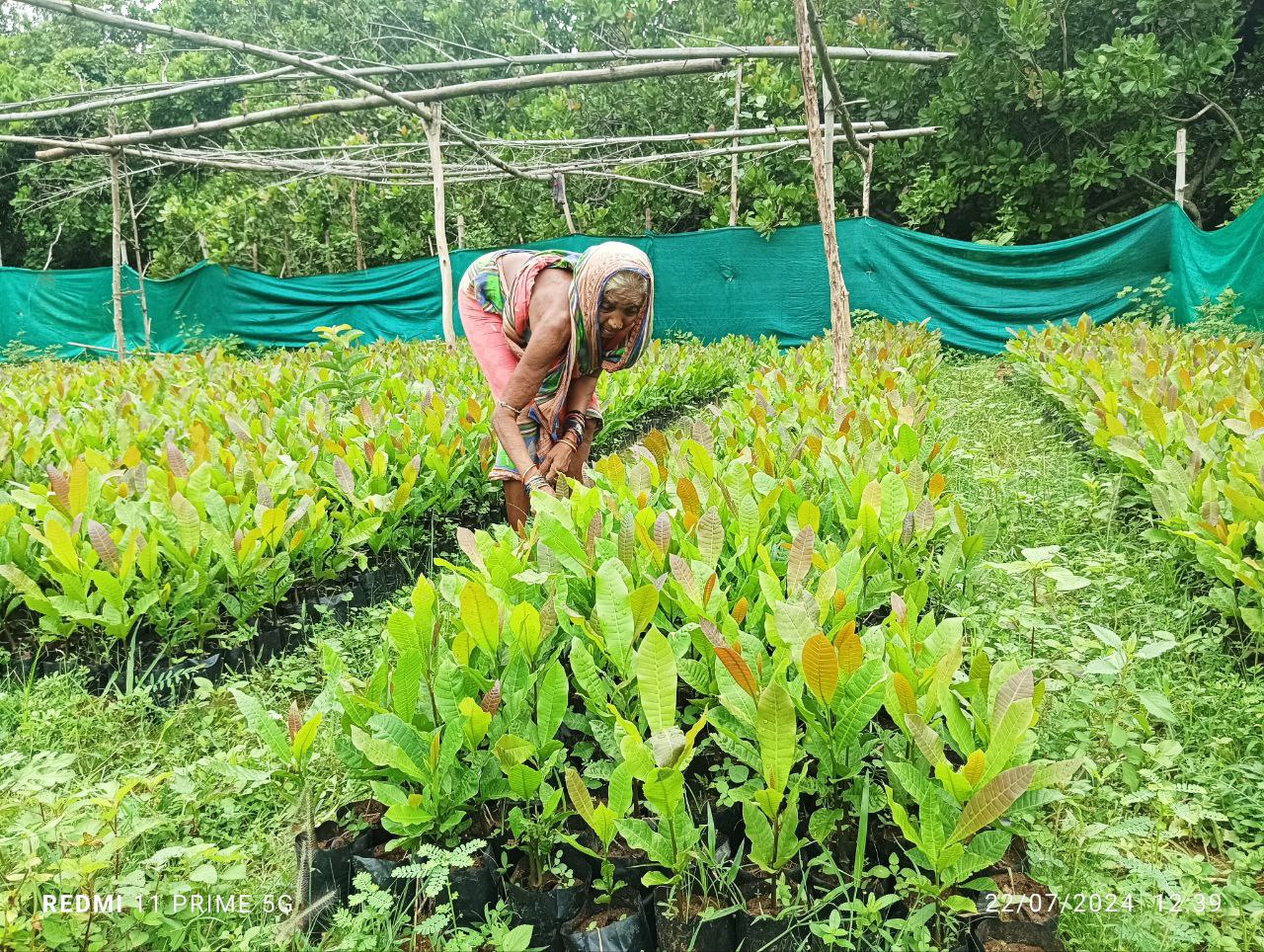
A member of the SHG taking care of the plants in the nursery.
Photograph by Dulhaba Odandra
In Gramadebati, a small Adivasi village in Odisha’s Ganjam district, summers are getting harsher. Deforestation in the surrounding hills has drained the ponds and wells that once sustained local farms, forcing families to cut back cultivation and trek long distances for water. With agriculture faltering, many have been forced to turn to daily wage work in nearby towns to make ends meet.
“We approached Gram Vikas in February 2024 to understand the issue,” says Satya Jani, member of Maa Bhagabati Self-Help Group, who lost her husband a few years ago and lives with her son presently. “They explained how deforestation has made the groundwater vanish. Trees slow down rainwater, let the soil soak it in, and recharge the wells. Without them, the water just runs off”.
Women leading change through forest restoration
The Self-Help Group had already been working closely with the Village Development Committee (VDC) to manage the village’s water and sanitation systems. In early 2024, after discussions with Gram Vikas’ field team, the 12 women SHG decided to venture into tackling the root cause of the problem: the loss of surrounding forests.
“During our meeting with Gram Vikas, we learned how shrinking forests cause soil erosion, alter the local climate, and drive away birds and animals. They suggested planting trees, managing forests together, and even starting a nursery to earn from sapling sales,” says Jani.
The SHG especially liked the idea of integrating trees into farmland as a way to restore green cover, recharge groundwater, and generate a source of income. Gramadebati’s location near other villages like Kaptapali and those in Tarasingi Panchayat also made it ideal for supplying saplings. Local varieties, they learned, were especially resilient and long-lived, and could also attract higher demand.
With support from Gram Vikas and B1G1, the twelve women SHG launched a plant nursery enterprise in May 2024. They collected seeds from nearby areas, prepared a mix of soil, sand, and organic manure, and, using polythene grow bags under an agro-shade net, began raising saplings for planting. Within months, 10,000 saplings – 8,000 cashew, 1,000 mango, and 1,000 jackfruit – were raised.
Rooted in resilience
It has been a little more than a year since the nursery was set up, but it has already begun drawing farmers from nearby areas. “Earlier, I had to travel 40 kilometres to Bhanjanagar to buy saplings. When the saplings are ready(at the nursery), I will buy 100 cashew plants from here and save on transport,” says 40-year-old Gadadhar Nayak from Kendupalli village.
Price is another attraction. The SHG sells cashew saplings at ₹5 each, compared to ₹15 in private nurseries. For small farmers like Jyoti Krushna Pradhan from Khetamunduli, the savings matter.
Others praise the plants’ longevity. “The ones from the Horticulture Department or private sellers are often grafted and last only five or six years,” says Chakrapani Jani from Nuasahi in Tarasingi Panchayat. “Our local varieties live longer and cope better with changing weather.”
For Satya Jani, in addition to the income, the nursery’s value is also deeply personal. “We are working together to improve the environment and earn income. I hope this helps educate my son. Since my husband died, I have relied on daily wages. Now, each group member takes turns caring for the saplings to keep the nursery going,” she says.
The nursery in Gramadebati is still young, but its potential is already visible. If even half the saplings survive and take root in surrounding villages, they will help stabilise soil, improve groundwater recharge, and increase biodiversity. In time, the income from sapling sales and mature trees could buffer families against the uncertainties of farming in a changing climate.
For the women of the Maa Bhagabati SHG, these rows of young plants represent more than a project – they are an investment in the land and in their community’s future.
The women preparing the poly bag with soil.
Photograph by Dulhaba Odandra
ACKNOWLEDGEMENT
Shikha Sharma edited the story.
ABOUT THE AUTHOR
Dulhaba Odandra, member Spearhead Team and Thematic Coordinator, Water Source Sustainability in Gram Vikas and Chandrika Patnaik leads content production within the Gram Vikas communications team.


RELATED BLOGPOSTS
When water is far away, women pay the price
In Kalahandi’s remote, hilly, Adivasi village of Raelpas, a solar-powered piped water system freed up women’s time and relieved years of physical drudgery.
A small Adivasi village takes big steps to secure its water future
Adivasi villagers in Bada Antarsing unite to restore groundwater, ensuring water security through community-led action.
One young woman’s journey proves women can be the change we need
Namita Rout helps rural entrepreneurs grow their businesses, improve incomes, and achieve financial independence.