One young woman’s journey proves women can be the change we need
StoryBy Soumyajit Dey
29 July 2025
Namita Rout, a civil engineering student from Kalahandi, joined the Gram Vikas Saathi Fellowship to help rural entrepreneurs in Odisha villages to build businesses and achieve financial independence.
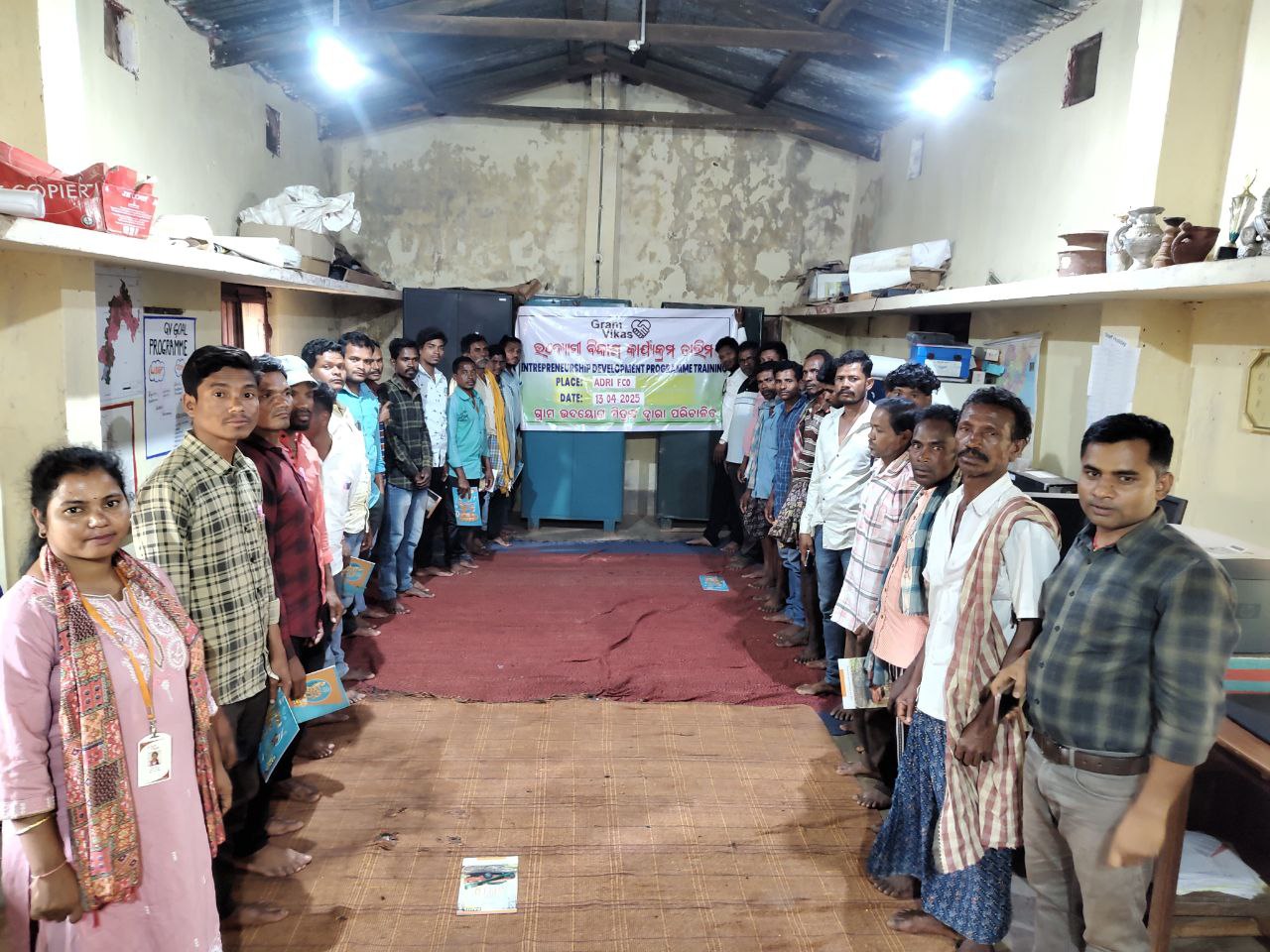
Namita Rout, a Gram Udyog Mitra from Kalahandi, with participants of the Enterprise Development Programme she facilitated in Adri village, as part of Gram Vikas’ rural entrepreneurship initiative.
Photograph by Soumyajit Dey
While studying in the third year of her B.Tech in Civil Engineering in Rayagada district, Namita Rout, from Dhamanguda village in the Gopalpur Panchayat of Kalahandi district, took up the Gram Vikas Saathi Fellowship — a one-year experiential learning programme. The Fellowship trains young people to establish themselves as service providers to their local communities and become agents of change.
“My father passed away a few years back, leaving my mother to support a family of five children by working as a cook in a school and running a small fast-food corner in the village,” Namita says. “She worked very hard to educate us and marry off my three elder sisters and an elder brother. Seeing the financial struggles and hardships my family went through, and on the advice of my elder sister, who had earlier worked with Gram Vikas, I decided to take up the Fellowship mid-way while studying for my engineering.”
Choosing her own ground
In a village where early marriage for girls is the norm and education is discouraged, Namita’s decision to become an engineer was a bold challenge to gender stereotypes. “When I passed Class 12 in 2019, my mother had already selected a groom for me,” she recalls. “I refused to get married so early and told her I planned to pursue engineering.”
Facing opposition from her family and pressure from her community, Namita left her home and lived in a rented one-room tenement when she enrolled for B.Tech. During this time, she continued her studies while participating in the Gram Vikas Saathi Fellowship Programme and trained as a Gram Udyog Mitra.
Learning to serve and lead
Gram Udyog Mitra (GUM) are Gram Vikas Saathis (GVS), who will be selected and trained as local business development service providers and a part of the rural enterprise development initiative of Gram Vikas.
The GUM programme started in October 2023, in five blocks in Surada, and Patrapur blocks in Ganjam, in Rayagada in the Gajapati district and in Thuamul Rampur block in Kalahandi district. Gram Udyog Mitra will become a part of the GVS network through the Gram Vikas Saathi Fellowship.
The Fellowship aims to foster entrepreneurial spirit among local youth, equipping them to address local issues and provide services to their communities. The fellowship offers thematic training followed by on-the-job training, certification, and ongoing support. This helps participants like Namita set up service-based enterprises that work with Village Development Committees, Panchayats, and government agencies to meet local needs.
Thirty Gram Vikas Saathis have been trained as GUMs since the Fellowship was rolled out, out of which 18 GUMs are working supporting 976 local enterprises across the three districts.
In April 2022, Namita underwent mandatory and optional training in leadership, enumeration, content creation, digital literacy, spoken English, and technology. After completing the Fellowship, she gained technical expertise as a Jala Bandhu, conducting water quality tests, training community members to survey water sources, and supporting village-level Water Security Planning. She also supported community initiatives such as managing plant nurseries, land development, and plantation activities. She worked as a service provider to Gram Vikas, the Village Development Committee (VDC), the Panchayat, government agencies, and other organisations in the Thuamul Rampur area.
Becoming a Gram Udyog Mitra
In October 2023, Namita enlisted for a three-month training as a Gram Udyog Mitra (GUM) under Gram Vikas’ entrepreneurship programme. A GUM is a Gram Vikas Saathi trained to provide business development support to rural entrepreneurs, enable market and financial linkages, and serve as a technical resource for entrepreneurs in enterprise development. The hands-on training addressed entrepreneurship challenges, provided insights into business planning and financing, and equipped participants with tools for sustainable enterprise development.
The training equips the GUMs with the skills and knowledge necessary to support prospective entrepreneurs in running a sustainable and profitable business.
Namita found the hands-on training immensely useful. “Most rural populations lack the technical skills and entrepreneurial judgement necessary to start and sustain a business.
Traditional mindsets and resistance to change hinder efforts. Access to capital remains the most significant hurdle for rural entrepreneurs. Limited financial literacy often prevents them from securing loans,” she shared.
Working with Bhikari to grow his enterprise
In May 2024, Bhikari Majhi, a 35-year-old from Dhuliguda village, attended an Enterprise Development Programme (EDP) conducted by Namita at Gram Vikas’ Kumudabahal office. After the session, he sought her help to improve his struggling grocery shop.
Namita visited him and advised him to set up his shop on the main road in the village instead of a room inside his house, add fast-selling items and increase the number of items to attract more customers. She helped him enrol with Rang De, an online P2P lending platform that partners with Gram Vikas, enabling Bhikari to access a ₹40,000 loan.
Following her advice, Bhikari improved his inventory, bought from two to three wholesalers, and began maintaining a day book. His monthly profits rose from ₹4,000 to nearly ₹10,000. He now plans to purchase a refrigerator to stock cold drinks before summer. Namita regularly follows the progress of his business and will continue supporting him over the next six months.
Helping Ganesh sustain his livelihood
In April 2024, Namita supported Ganesh Majhi, 30, from Gopalpur village, to get a ₹60,000 loan through Rang De. Ganesh ran an Aadhaar centre but faced difficulties due to frequent power cuts. After discussing his challenges, she helped him apply for a loan to purchase a laptop and inverter.
With better equipment and backup power, Ganesh expanded his services, helping people apply for jobs, get photocopies, and process voter and PAN cards. His income rose from ₹4,000 to ₹9,000. Now studying law, Ganesh also cares for his two younger sisters, managing household expenses after losing both parents.
Work that multiplies
Namita recalls a time when she struggled to find a job. Today, she not only sustains herself but also helps others create income opportunities. “I once struggled to find a job, but now I am confident not only in sustaining myself but also in helping others create income opportunities,” she says.
As part of Gram Vikas’ initiatives, Namita has supported 33 self-help group visits, identified 58 potential entrepreneurs, and facilitated Entrepreneurship Development Programmes (EDPs) for 30 individuals. She has prepared Business Plan documents for 29 entrepreneurs, of which 20 have been successfully grounded, including both new ventures and revived businesses. She has also facilitated skills training for 12 individuals and supported credit linkages for several aspiring entrepreneurs.
Manjary, who leads the Enterprise Development Programme in Gram Vikas, has been working with the Gram Udyog Mitra since the beginning. She says,, “Witnessing Namita’s journey has been truly inspiring for me. Her courage to not settle for the societal norms and her commitment to support such grounded work capture the essence of the Gram Udyog Mitra programme. She now has the knowledge and skills to help communities better select and run sustainable businesses. Change-makers like her remind us that lasting transformation begins from within the community.”
In addition to her work as a Gram Udyog Mitra, Namita has trained herself in sewing and tailoring. She now earns additional income from it and teaches other women in her village, helping them take steps towards financial independence. Gram Udyog Mitras like Namita are also building their own service enterprises, providing paid and skilled services to Gram Vikas, SHGs/FPGs and community institutions.
Namita’s story reflects how consistent, locally rooted leadership can expand livelihood choices and enable sustainable economic progress from within the community.
Bhikari Majhi at his grocery shop in Dhuliguda, expanded with support from Gram Vikas and Gram Udyog Mitra Namita Rout.
Photograph by Soumyajit Dey
ACKNOWLEDGEMENT
Soumyajit Dey is a Thematic Coordinator for Planning, Monitoring, Documentation and Communication helped collected data for the story. Priya Pillai edited the story.
ABOUT THE AUTHOR
Soumyajit Dey, is a Thematic Coordinator for Planning, Monitoring, Documentation and Communication in Gram Vikas.


RELATED BLOGPOSTS
When water is far away, women pay the price
In Kalahandi’s remote, hilly, Adivasi village of Raelpas, a solar-powered piped water system freed up women’s time and relieved years of physical drudgery.
Women create a forest of opportunity to boost green cover and livelihoods
A self-help group in Gramadebati tackles water scarcity and strengthens livelihoods by establishing a nursery enterprise.
A small Adivasi village takes big steps to secure its water future
Adivasi villagers in Bada Antarsing unite to restore groundwater, ensuring water security through community-led action.