When water is far away, women pay the price
StoryBy Ipsita Shit
20 April 2026
The Indravati River cuts the remote Adivasi habitation of Raelpas off from the nearest road. For years, women walked steep hillside paths multiple times a day to fetch water from a faraway dug well. Today, all households get water from taps through a community-built, solar-powered piped water system. This is the story of what water at home gave back to the women of Raelpas, and what it took to get it there.
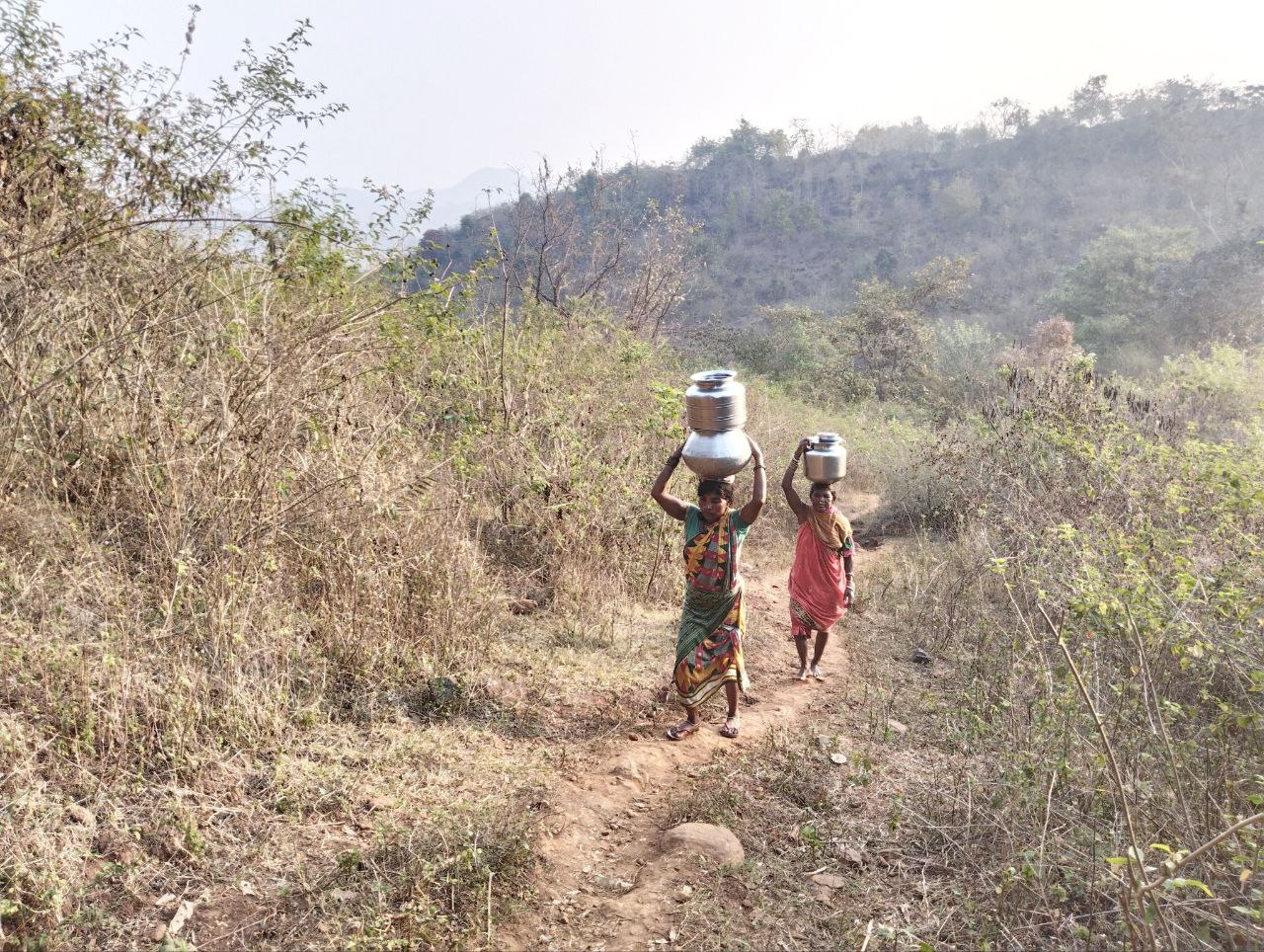
Women carrying water on their heads along the steep hillside path from the dug well to the village.
Photograph by Siba Kumbhar
To reach Raelpas, you cross the Indravati River by boat. On the other side, a three-kilometre walk through rocky hills and uneven terrain brings you to a small cluster of homes scattered across the slopes. The path is narrow. And for the eight households that live here, it has always meant that everything from food, medicine, to schooling and markets requires crossing that river first.
Raelpas is a habitation within Biribad Revenue Village, in the Adri Gram Panchayat of Odisha’s Kalahandi District. Its twin habitation, Biribad, sits on the other bank and connects to the outside world by road. Raelpas does not. The river, which is a scenic feature for a new person who visits the village, is a daily barrier for its residents.
When a community lives this far from the nearest road, the gap between it and government services widens. Safe drinking water schemes reach roadside villages first. Remote habitations wait. Raelpas waited for a long time.
A crisis that falls on women first
Globally 2.1 billion people — one in four — still lack access to safely managed drinking water.
In two out of three households without water on-premises, women are primarily responsible for collection. In 53 countries with available data, women and girls collectively spend 250 million hours every day on water collection — more than three times the time spent by men and boys.
These numbers describe a pattern. What they do not fully capture is what that pattern costs in time, in health, in dignity, and the immeasurable, unnoticed erasure of a day.
In communities without piped water, a woman’s morning does not begin with her own needs. It begins with everyone else’s. The walk to the water source comes before the meal, before the wash, before any moment that belongs to her.
When water is absent from the home, so is the privacy of a bath, the dignity of a toilet used without inconvenience, the small rituals of personal care that most people do not think twice about. These are not small losses. They accumulate across a lifetime.
Raelpas is one such community. And for the women here, the distance to water would be best measured in hours, in effort, and in what had to be given up for it.
Fifty years at one dug well
The community’s relationship with displacement goes back half a century. When the Indravati Dam was built, this Adivasi community lost its original settlement to the rising water. Bisu Majhi, 65, the village’s President, holds that memory clearly. “Our habitation sank under the dam of Indravati,” he said. “Since then we have lived here. That dug well was our only source of water.”
For all eight households of Raelpas, that single dug well served every need from drinking, to cooking and washing. The well sat 200 metres from the nearest home, at the bottom of a steep hillside. For women, it defined the shape of each day.
Laxmi Majhi, 55, described what the walk meant. “Tole jai ki, ghati rasatare munda upore boi ke pani anuchi, besi kosto laguche.” Meaning: Going down is one thing. Carrying water back up the slope on your head is another. She and the other women of Raelpas made that trip five to six times a day, spending two to three hours on water collection alone.
Without water at home, the toilets that existed in the village went unused. A bath was not a private, unhurried act. It was something arranged around the logistics of carrying enough water up a hill.
What remoteness costs women
When water is far, women do not simply walk further. They give up time that could go to farming, to income, to rest, to their children. A finding suggests that time saved from water collection is the single biggest way access to water improves a household’s finances.
The physical toll of carrying heavy loads over uneven terrain accumulates across years. And because water collection is rarely counted as labour, its cost remains invisible in every ledger except the one women carry in their bodies.
In Raelpas, the difficulty was compounded at every level. The hillside made the walk steep. The scatter of households across the slopes meant the distance was longer for some families than others. The river cut the community off from any outside support that might have addressed the problem sooner.
Dhanmati Goud, 65, spoke from decades of lived experience. “Access to water was the biggest problem for us. We women faced a lot of struggle to carry water and used to spend a lot of time on it.”
The remoteness of Raelpas had kept it outside the reach of safe drinking water initiatives being carried out in other villages of the Adri Gram Panchayat. Being on the wrong side of a river, in a landscape without roads, meant the village simply did not appear on the priority lists.
A survey reaches the other side
In December 2023, Gram Vikas staff conducted door-to-door surveys across Adri Gram Panchayat as part of the Water Secure Gram Panchayats programme. They crossed the river to reach Raelpas. What they found was a community with an urgent, unmet need and no immediate prospect of government support.
Gram Vikas proposed a solar-powered piped water system. A motor would lift water from the dug well into a 5,000-litre storage tank. From there, pipes would carry water to standposts near each of the eight households. Running on solar power, the system would not depend on the electricity grid, which the village cannot reliably access.
The community responded immediately. Work began at the end of January 2024.
Everything arrived by boat
What followed was a feat of collective logistics. With support from the Azim Premji Foundation, Gram Vikas procured the materials needed for the piped water system. Pipes, solar panels, a water motor, and the 5,000-litre tank all had to reach a village with no road connection.
Every large item crossed the Indravati by boat, one trip at a time.
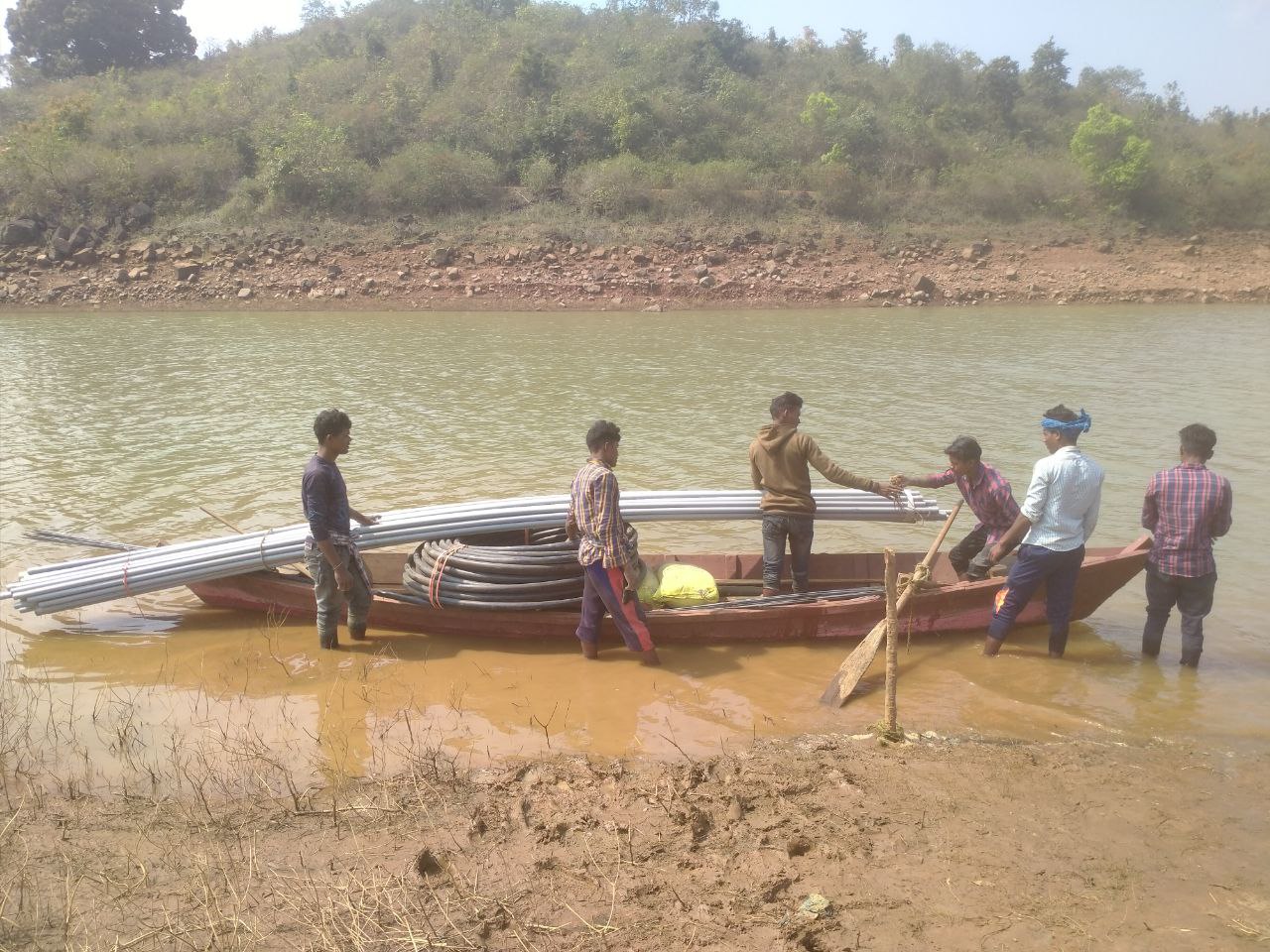
Community members loading pipes onto a boat to cross the Indravati River, with the hills of Raelpas visible in the background. Photograph by Dalei Mallik.
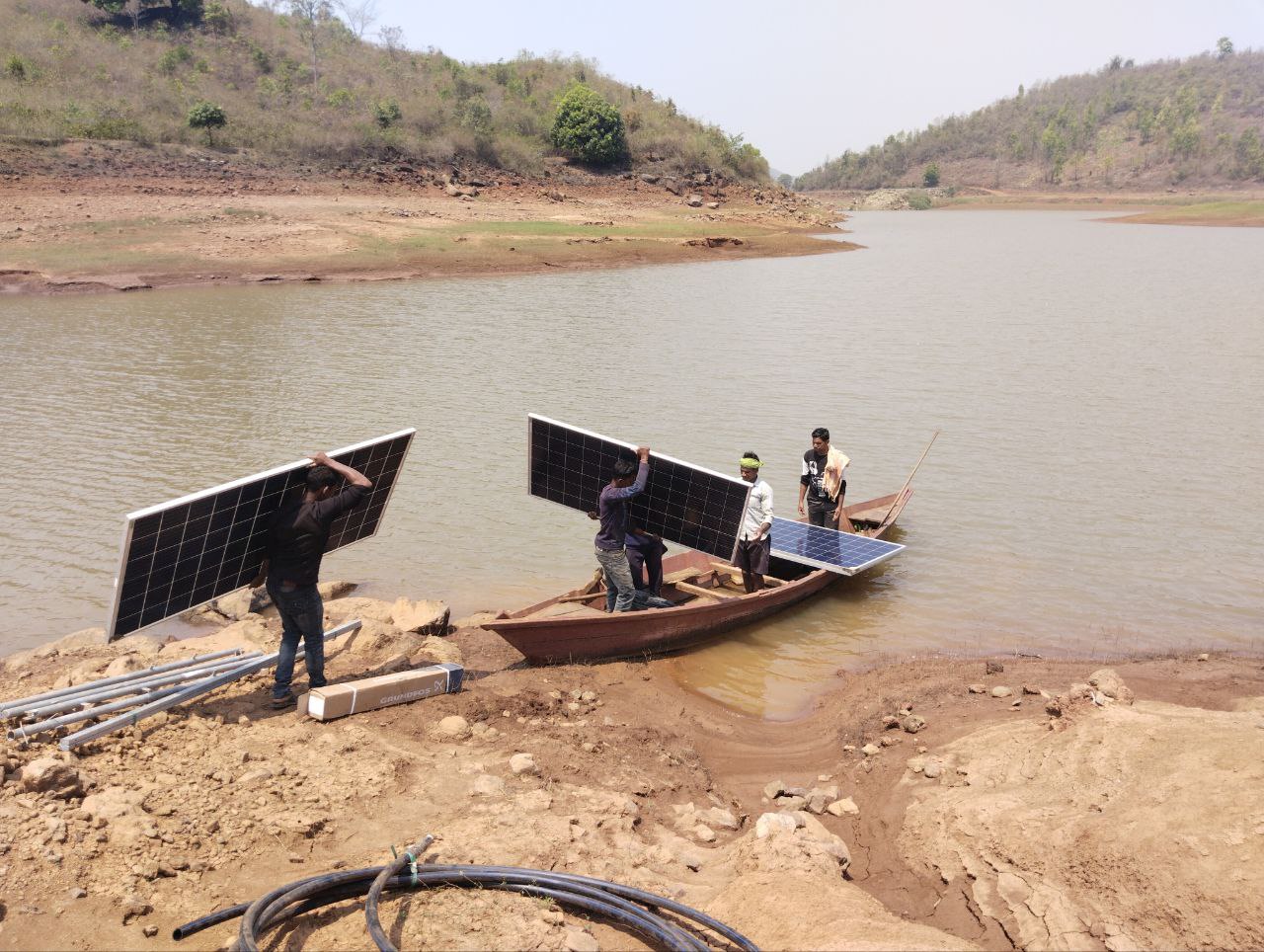
Solar panels being carried across the Indravati River by boat, en route to Raelpas. Photograph by Siba Kumbhar.
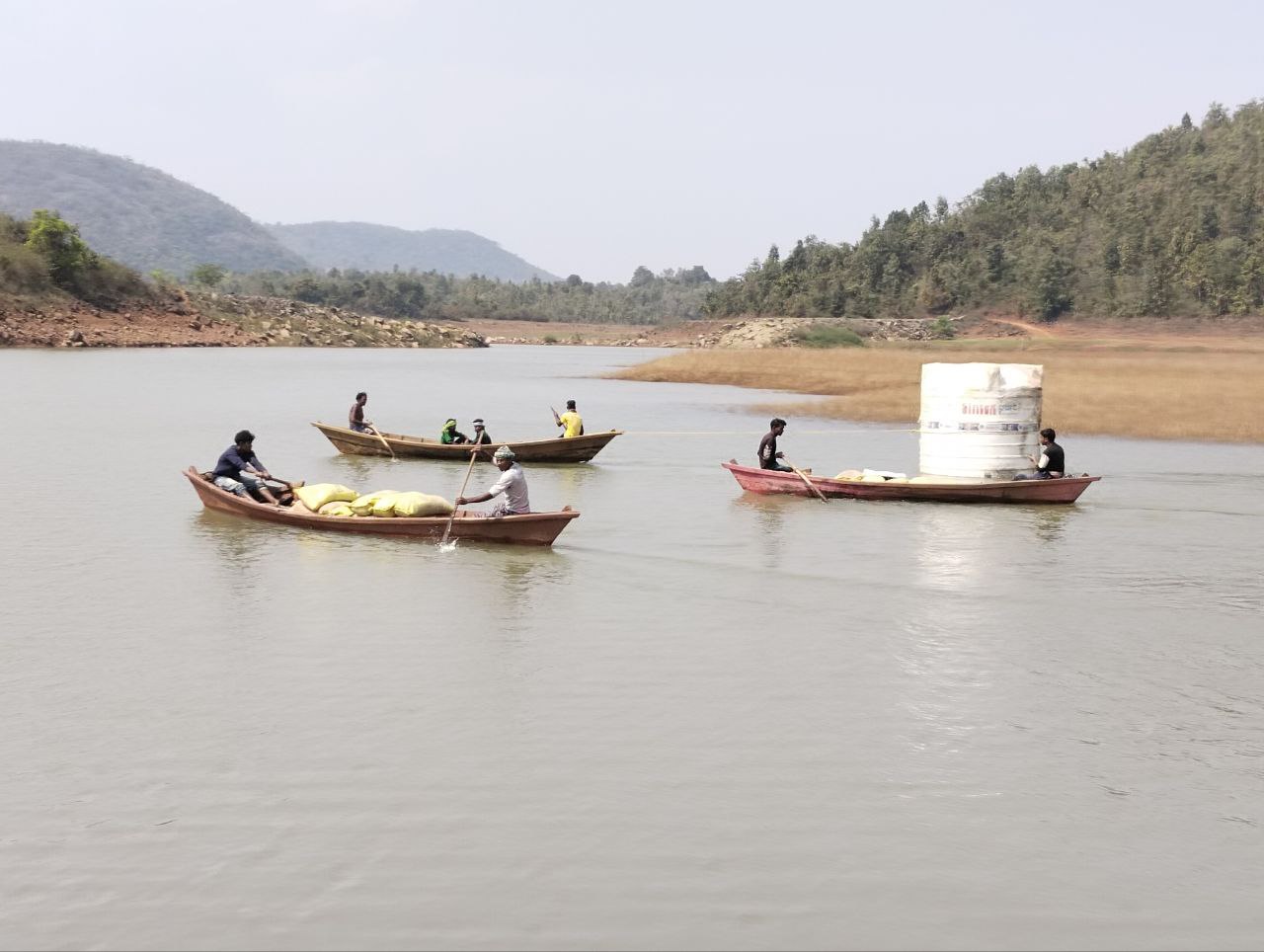
Boats crossing the Indravati River carrying materials for the piped water supply system. Photograph by Siba Kumbhar.
The dug well, which had been four feet deep, was deepened to ten feet to increase the volume of water it could hold. The solar motor was installed. The tank was set in place on higher ground. Pipes ran from the tank to standposts built near each home. Water also reached six Swachh Bharat Mission toilets constructed in the village.
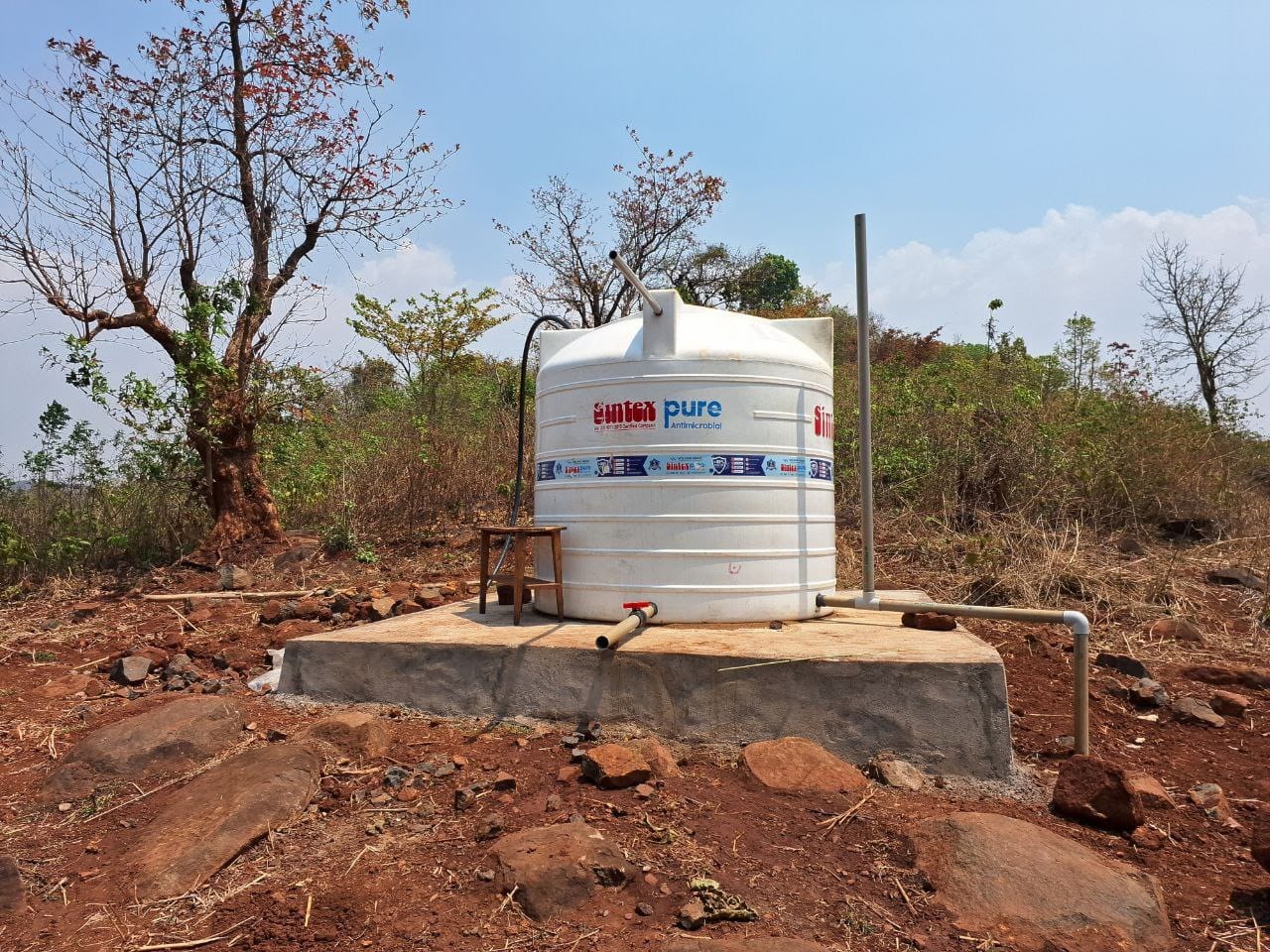
The 5,000-litre water storage tank installed at Raelpas, connected to the solar-powered distribution system. Photograph by Siba Kumbhar.
The community did not wait to be given everything. They sourced sand and stone chips themselves for the standpost platforms. They purchased every tap for the household standposts and the toilet connections with their own funds.
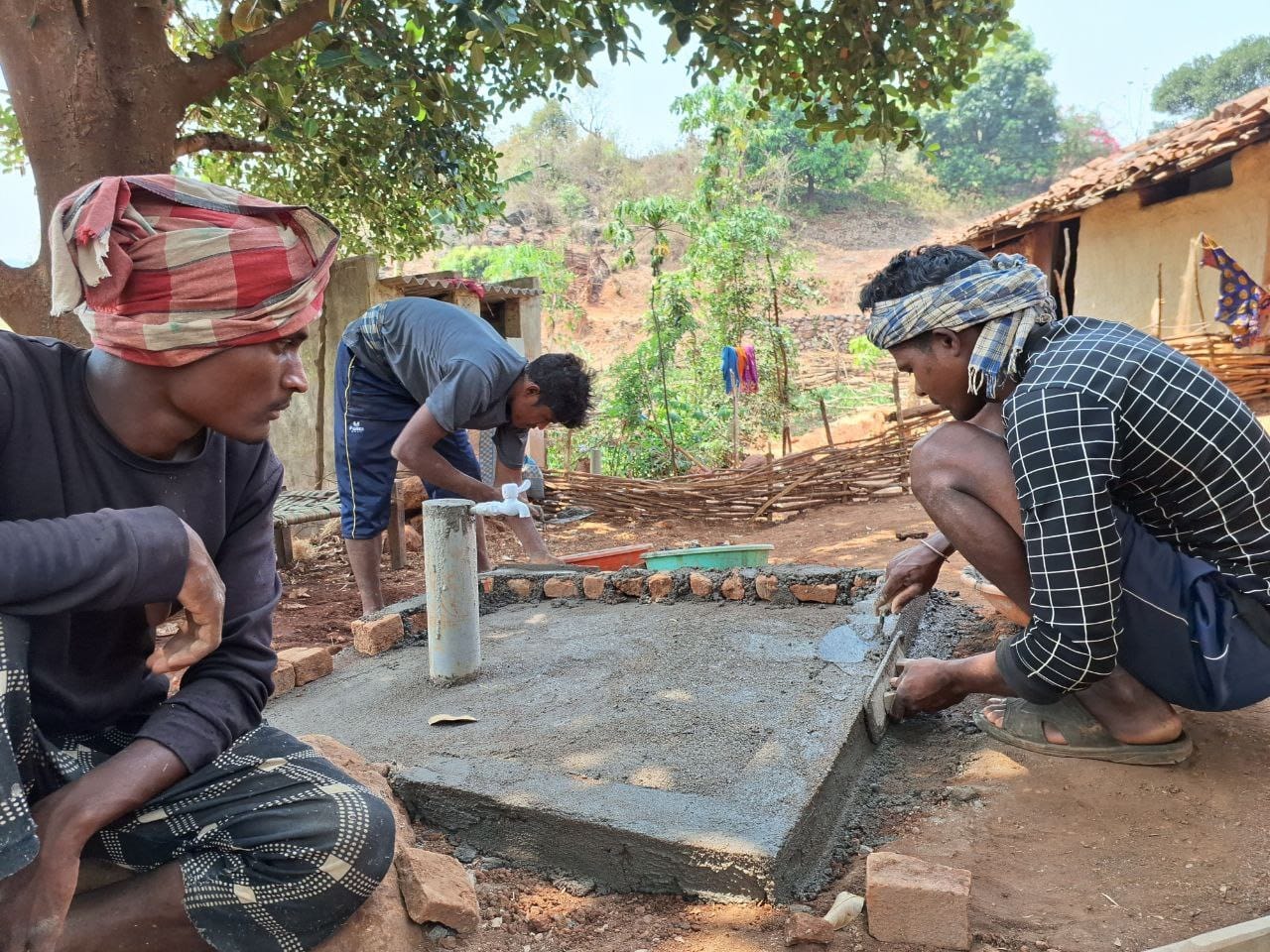
Community members building the standpost platform at a household in Raelpas. Photograph by Siba Kumbhar.
By March 2024, water flowed from taps at every home in Raelpas.
What changed
Bisu Majhi looked at a tap and said, “That dug well was our only source of water. Seeing water coming from the taps is like our dream come true.”
For the women of Raelpas, the change was immediate and physical. The hours spent on the hillside each morning belong to them now. The weight carried for decades is gone. Water at the doorstep meant that toilets in the village could be used. It gave back the privacy of a bath, the ease of a morning routine, the dignity of not having to plan every personal need around a two-hour walk.
Dhanmati Goud, who had carried water for most of her life, said it herself. “I am feeling very happy now.”
What Raelpas Tells Us
The remoteness of Raelpas is not unusual in Odisha. Many communities live beyond the reach of roads, across rivers, up hillsides. In each of them, the burden of water collection falls most heavily on women. And in each of them, that burden is both a symptom and a cause of deeper exclusion.
What the Raelpas intervention shows is that remoteness is not an insurmountable barrier. It requires a different kind of effort — boats instead of trucks, solar power instead of grid electricity, a ground-level team willing to cross the river and knock on every door.
It requires a partner like the Azim Premji Foundation, that chose to fund the WSGP programme to reach difficult terrains, where the need is real and the delivery is hard.
And it requires a community that shows up, informs the intervention, and contributes what it can.
Dhamati Majhi collecting water from the household standpost outside her home in Raelpas.
Photograph by Siba Kumbhar
ACKNOWLEDGEMENT
Sukriti Ojha edited this story.
ABOUT THE AUTHOR
Ipsita Shit is a Junior Manager in the Planning and Monitoring team at Gram Vikas.


RELATED BLOGPOSTS
Women create a forest of opportunity to boost green cover and livelihoods
A self-help group in Gramadebati tackles water scarcity and strengthens livelihoods by establishing a nursery enterprise.
A small Adivasi village takes big steps to secure its water future
Adivasi villagers in Bada Antarsing unite to restore groundwater, ensuring water security through community-led action.
One young woman’s journey proves women can be the change we need
Namita Rout helps rural entrepreneurs grow their businesses, improve incomes, and achieve financial independence.