“Now My Son Eats What I Grow”: A Small Garden, A Useful Change
StoryBy Arya M Sankar
15 July 2025
Backyard gardens in Odisha, supported by the CROPS project, are improving nutrition, empowering women, and promoting climate resilience through greywater reuse, sustainable farming, and diverse vegetable cultivation.
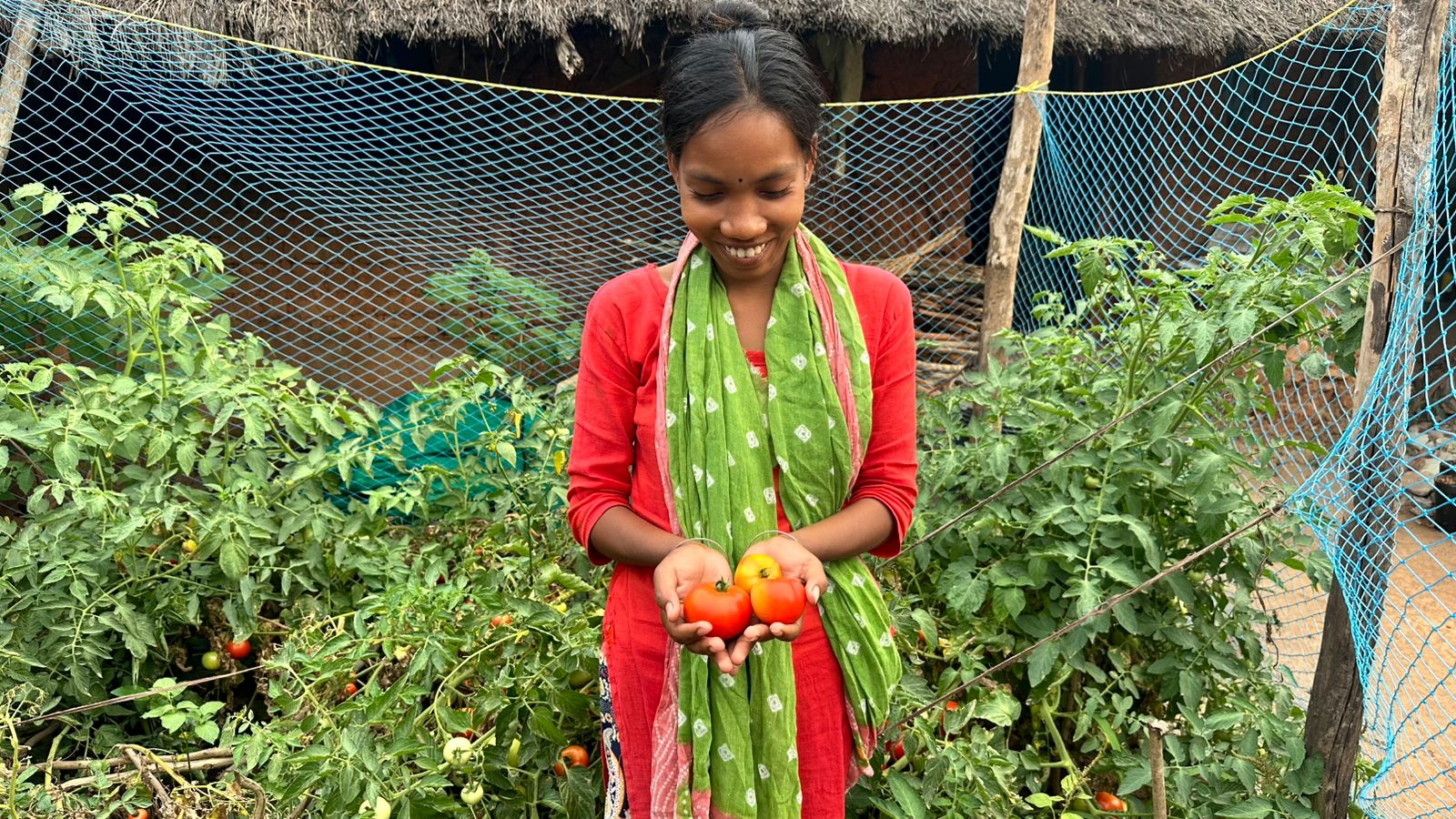
Manjary Sabar from Tumba village displays the fresh produce from her kitchen garden.
Photograph by Arya M Sankar
In Tumba village in Odisha’s Ganjam district, what began as small kitchen gardens has gradually turned into a more focused effort with the introduction of Backyard Gardens that use grey water.
For many, like Mammali Sabar, a mother of a two-year-old, the garden holds personal meaning. “I harvested 10 kilos of tomatoes because of the good rainfall and the seeds we were provided,” she says. “Whatever I grew, I made sure my son got them first. This support from the backyard garden is very helpful, and we will continue to take care of it.”
She explains that the first share of every harvest goes to her child. That everyday act feeding her son from what she has grown herself shows how these gardens are helping families maintain better nutrition at home.
For Mammali and her family, the garden means they can offer fresh vegetables to their child without fully depending on the market. Of the 92 households in Tumba, 44 now grow their own vegetables in their backyards using water recycled from their bathrooms and kitchens.
Another resident, Balakrishna Sabar, shares a similar story. “We harvested five kilos of tomatoes, two kilos of beans, and some radishes and carrots,” he says. “Now we don’t have to depend on the market for these.” These gardens are already reducing families’ reliance on store-bought vegetables while encouraging healthier, more diverse diets at home.
To support this change, each participating household received a variety of seeds, including tomato, chilli, radish, long beans, carrots, bitter gourd, pumpkin, brinjal, cucumber, and two types of spinach. While crops like potatoes and cabbage are still purchased from the market, the gardens now meet a significant portion of each family’s daily needs.
Fencing nets were also distributed to protect the gardens from monkeys, chickens, and cattle. Another major benefit of the project was the greywater channelization system, which helps households direct wastewater from kitchens and bathrooms directly into their gardens.
The project provided technical training, covering bed preparation, seed sowing, organic pesticide preparation, and compost making for all households involved in the project.
This transformation is part of the Climate Resilient Odisha Produce Study (CROPS), a collaborative initiative by Emory University, WorldVeg, CARE, and Gram Vikas. It began in 2023 with trials in 12 villages and expanded in September 2024 to reach 946 households across 45 villages in the districts of Ganjam, Gajapati, and Nayagarh.
The project aims to help communities build resilience against climate change while improving household nutrition through hands-on training, technical knowledge, and continuous support with a special focus on women, dietary diversity, and local adaptation.
As Mammali Sabar says, “This is the kind of help we get from the backyard kitchen. And in the future also, we will take care of it.”
Reena Sabara from Tumba village displays fresh leafy greens from her backyard garden, nurtured using recycled greywater as part of a community effort to grow nutritious food at home.
Photograph by Arya M Sankar
ACKNOWLEDGEMENT
Ayisha Noora P.K. – Thematic Coordinator in Planning, Monitoring, Documentation, and Communication; Sheethal T.S. – Team Leader, WASH-Nutrition Resource Group; Siba Kumbhar – Field Expert, Sanitation & Hygiene. Priya Pillai edited the story.
ABOUT THE AUTHOR
Arya M Sankar is a Junior Manager in the Communication Team, Education, and Youth.


RELATED BLOGPOSTS
Women create a forest of opportunity to boost green cover and livelihoods
A self-help group in Gramadebati tackles water scarcity and strengthens livelihoods by establishing a nursery enterprise.
A small Adivasi village takes big steps to secure its water future
Adivasi villagers in Bada Antarsing unite to restore groundwater, ensuring water security through community-led action.
One young woman’s journey proves women can be the change we need
Namita Rout helps rural entrepreneurs grow their businesses, improve incomes, and achieve financial independence.