Turning canal overflow into crop success
StoryBy Prabhat Kumar Jena, and Chandrika Patnaik
23 June 2025
Barapudugia farmers built a check dam to store canal water, ensuring irrigation amid erratic rainfall. This community-driven effort, supported by Gram Vikas and HDFC Bank Parivartan, improved paddy yields, secured livelihoods, and strengthened climate resilience.
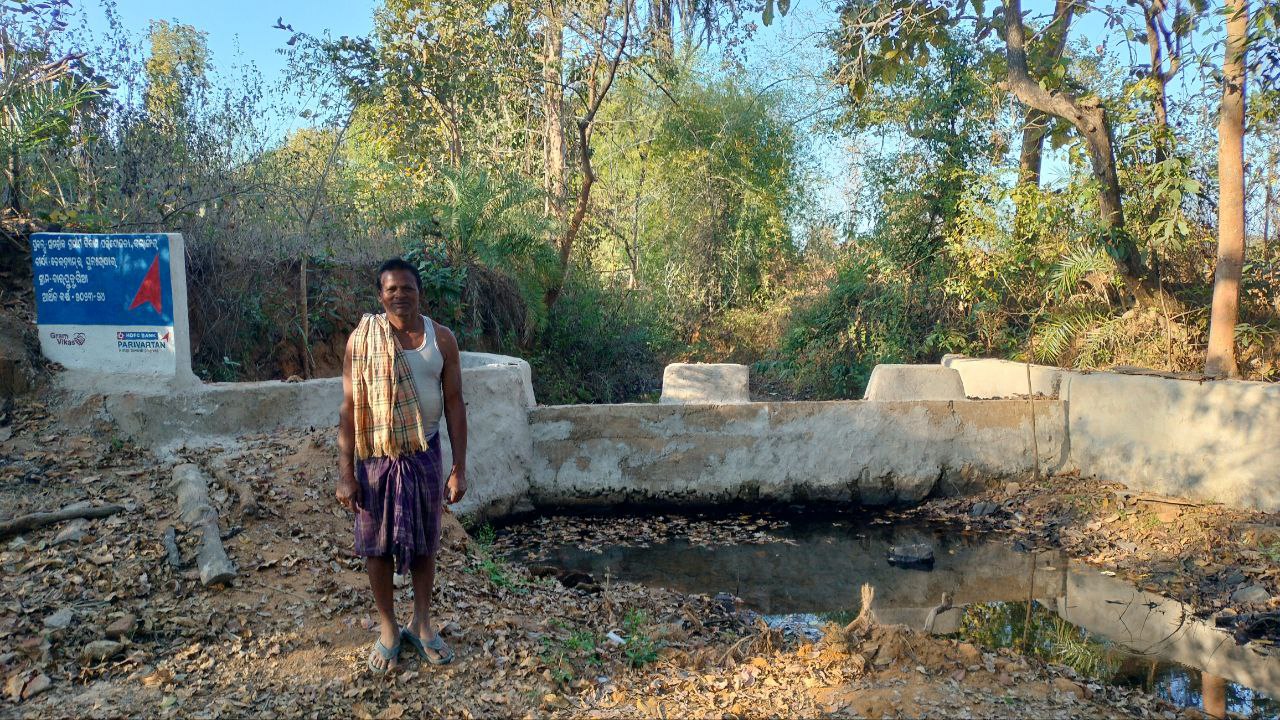
Chaitanya Sa, a farmer from Barapudugia village, stands in front of the community-built check dam that now ensures water security for local farmers, even during erratic monsoons.
Photograph by Prabhat Kumar Jena
“Farmers like me have faced numerous challenges, from excessive rains to prolonged winters, droughts, and floods due to extreme temperatures. The number of precipitation days has reduced, making cultivation difficult,” says Chaitanya Sa, a farmer from Barapudugia village in Odisha’s Balangir district. He owns two acres of cultivable land and leads both the Village Development Committee (VDC) and the Maa Samalei Farmers Producer Group (FPG).
Barapudugia is a predominantly rain-fed region, where most farmers are small and marginal, with landholdings between 0.5 and 5 acres. Paddy is the primary crop, heavily dependent on monsoon rains. However, erratic weather patterns and dry spells have made agriculture increasingly unpredictable, threatening both food security and income.
Farmers in the area have traditionally relied on rainfall and cultivated little beyond the monsoon season. As rainfall becomes less reliable, even monsoon farming has become difficult. “If there weren’t enough rains during the monsoons, our crops withered under the unrelenting heat. The weight of the crop and, consequently, the harvest would be low,” explains Chaitanya.
A community solution to water scarcity
A canal runs through Barapudugia village, passing near 20 acres of farmland owned by twelve farmers. During the rainy season, the canal overflows, and the farmers saw an opportunity. They decided to divert and store the excess water to irrigate their fields and approached Gram Vikas for support.
In May 2023, during a VDC and FPG meeting, the farmers proposed building a check dam. After field visits and feasibility checks, Gram Vikas agreed to construct the dam, while the farmers committed to contributing labour. The process involved digging, laying bricks, and reinforcing the structure. A pipe was also laid to divert water from the canal directly into the farmland.
“This was a crucial step in our journey towards sustainable water management,” says Chaitanya. “The check dam ensures that even if it doesn’t rain enough, our crops receive water until harvest.”
Jayadeb Sa, another member of the FPG, shares, “In earlier years, the lack of water damaged our crops and made farming unpredictable. Sometimes, our harvests weren’t enough to feed our families for the whole year. Since the dam was built, twelve of us have cultivated paddy with ample water, ensuring a good yield and better food security.”
Better yields, shared gains
For farmers like Jayadeb and Chaitanya, the check dam has brought visible improvements. “Earlier, I used to harvest 50 quintals of paddy from my two acres. After the check dam, I harvested 52 quintals in December 2023,” says Jayadeb. “Previously, I kept 30 quintals for my family and sold 20 quintals for ₹48,000. This year, I kept the same 30 and sold 22, earning ₹52,800.”
Chaitanya notes that early-stage submergence of paddy saplings—ensured by the dam—was key to the healthier crops and higher yields. “Our crops suffered earlier due to intermittent rainfall and weak grains. Now, we have consistent access to water at the most crucial time.”
He believes this initiative will continue to benefit the community for years. “This is collective action. It’s working.”
Jayadeb adds that the FPG model could be useful for other villages. “In our group, small and marginal farmers pool land, labour, and resources to improve income. It’s a good strategy that others can learn from.”
Through this locally driven solution, Gram Vikas and its partners are helping farmers adapt to changing climate conditions and strengthen water security. The check dam at Barapudugia stands as an example of how infrastructure, knowledge, and community effort can come together to support resilient agriculture.
This initiative is part of the Holistic Rural Development Programme (HRDP), implemented by Gram Vikas in collaboration with HDFC Bank Parivartan across 20 villages in four blocks of Balangir district—Balangir, Loisingha, Deogaon, and Antarla—with a strong focus on agriculture and farmer empowerment.
Chaitanya Sa irrigates his farmland using water from the check dam, a community initiative that has made year-round cultivation possible in Barapudugia village.
Photograph by Prabhat Kumar Jena
ACKNOWLEDGEMENT
Prabhat Kumar Jena, a Thematic Coordinator for Planning, Monitoring, Documentation and Communication helped collect data for the story. Priya Pillai edited the story.
ABOUT THE AUTHOR
Prabhat Kumar Jena, is a Thematic Coordinator for Planning, Monitoring, Documentation and Communication and Chandrika Patnaik manages Communications in Gram Vikas.


RELATED BLOGPOSTS
Women create a forest of opportunity to boost green cover and livelihoods
A self-help group in Gramadebati tackles water scarcity and strengthens livelihoods by establishing a nursery enterprise.
A small Adivasi village takes big steps to secure its water future
Adivasi villagers in Bada Antarsing unite to restore groundwater, ensuring water security through community-led action.
One young woman’s journey proves women can be the change we need
Namita Rout helps rural entrepreneurs grow their businesses, improve incomes, and achieve financial independence.